The Jass Age Fashion the Jazz Age Fashion
Dolores's interest in fashion history dates from her teenage years when vintage wearing apparel was widely available in thrift stores.
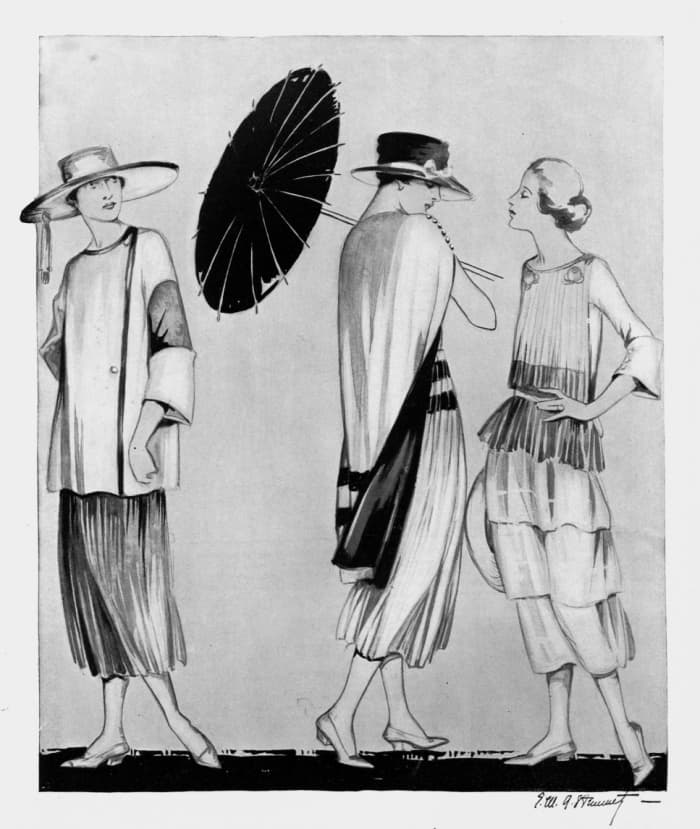
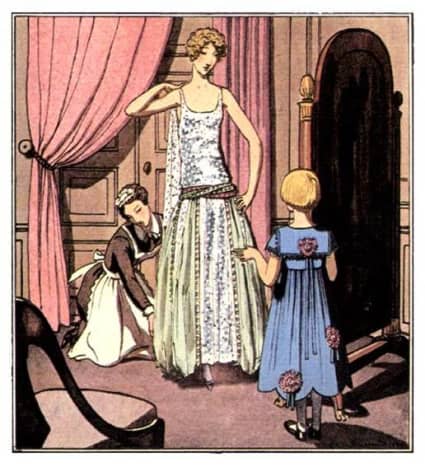
Fashion sketch from Harper's Bazaar show 1920s shorter hemlines and loose silhouette
wikimedia commons, public domain
Hallmarks of Women's Fashions of the 1920s
Mode in this era was typified past the following:
- Less tailoring, leading to an abandonment of the corset
- A tubular silhouette that erased the typical feminine shape
- Dropped waistlines that created a long, slim effigy
- Shorter hemlines that fabricated it easier to drive cars and move quickly
Enter the Jazz Age
Women'due south fashions of the 1920s are a big role of the Jazz Historic period identity. The 1920s arrived on the heels of World War I, the 1918 Flu Pandemic, runaway inflation followed by an xviii month depression. When the American economic system bounced back in a big mode in 1921 information technology lead to a youthful exuberance that was personified past the flapper.
Reverse to popular misconception, the brusque skirts and bold makeup of the flapper did not rule the fashion of the mean solar day but were an iconic and memorable look. Fashion periods are usually distinguished past the female silhouette, which in the 20s presented a boyish figure with flattened breasts and loose wear for most of the decade.
More Empowerment for Women
The drop-waist shift dresses of the 1920s relieved women of the last vestiges of Edwardian formality. Less tailoring, likewise equally the availability of the sewing machine, meant that women could hands make fashionable clothing at dwelling then that high fashion was no longer restricted to the elite.
Women felt empowered when they won the right to vote (1920 in the U.s.a., 1928 in Britain). The widespread utilize of the motorcar, radio, and increased educational opportunities encouraged young women to cut off their hair and kick upwards their heels.
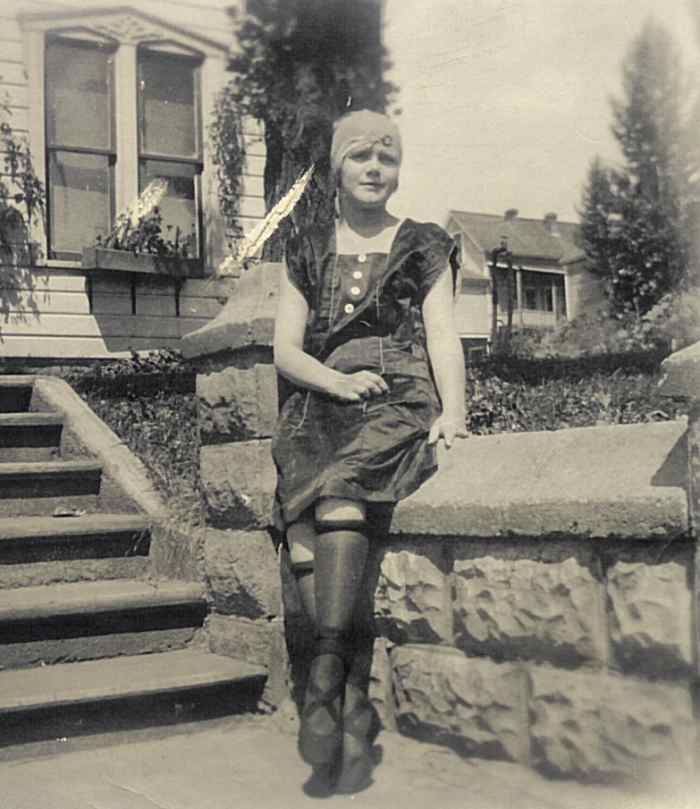
1920's Girl With Rolled Stockings
Uploaded by Piotr Skut; wikimedia commons; Public Domain
The New Culture of the 1920s
During World War I, immature women worked outside the habitation more they had in the past. They drove cars and disregarded tradition. Gender specific clothing began to fall by the wayside afterward women worked in munitions factories during the Great State of war (1914 - 1918).
A kind of cynicism that came in the aftermath of the Globe State of war I and the devastating influenza pandemic of 1918 created a youth culture that glorified fast living, dancing, and the exciting sounds of syncopated jazz described by the writer F. Scott Fitzgerald in his classic novel The Great Gatsby. The term "The Lost Generation" is credited to Gertrude Stein by Ernest Hemingway to draw a loss of faith in the establishment and traditional values.
"The Lost Generation"
The youth drank in carefree condone of Prohibition (1920 - 1933) which outlawed the industry, sale, and distribution of booze only not its consumption. Young people lost respect for potency and traditional morals. Immature women smoked cigarettes and danced the Charleston and Blackbottom, typified by fast, jerky movements. Short skirts immune greater liberty to dance; and plunging necklines, and low backs put more of the female trunk on display than ever before.
Flappers incorporated an unusual utilize of clothing into the wild new style. Flappers rolled stockings below the knee, and wore unhooked condom galoshes that flapped when they walked.
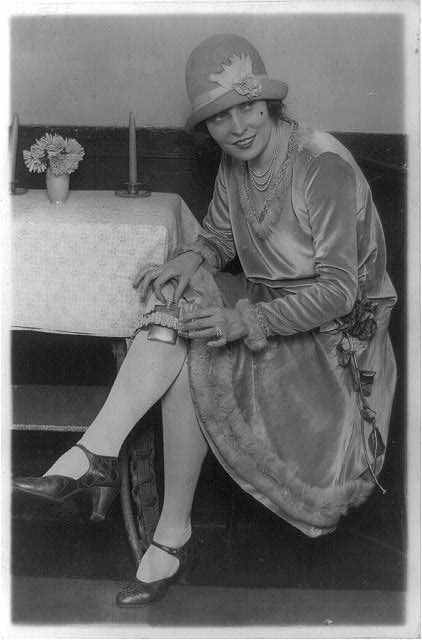
1926 Flapper With Flask
Uploaded past Entheta; wikimedia commons; P{ublic Domain
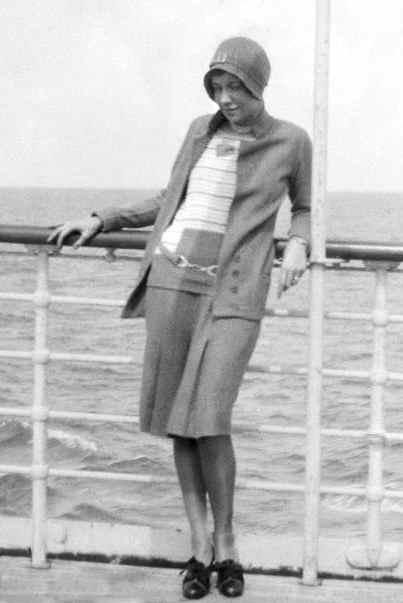
Uploaded past Across My Ken; wikimedia commons; GNU Free Documentation Licence
Hemlines
Not all women wore the brusk skirts or the flippant styles of the flappers. Brim hemlines began to ascension in 1913 when skirts stopped just to a higher place the ankles. By 1918, hemlines had risen to just beneath calf length and for the next several years showed variations of a few inches one way or another.
Scroll to Continue
Read More than From Bellatory
Up and Downwards
In the early 1920s, uneven hemlines gave the appearance of shortening when uneven, scalloped, and handkerchief hems became stylish. 1925 saw the dramatic rise of skirt hems into the Flapper style that has come up to typify women's vesture of the Roaring Twenties, simply was a relatively curt lasting phenomena.The brusque skirts of the Flapper was mostly worn by younger women while older women wore longer skirts.
By 1929, asymmetrical brim hems brought hemlines back downward. Merely fashions brief flirtation with brusque hemlines gave usa the image of the modern woman, a fashion that continued (more or less) throughout the 20th century and into the 21st century.
Women's Underwear
Rejection of the stiff tailoring of before styles made corset sales plummet. A new, elasticised corset replaced the onetime, stiff, restricted whalebone corsets of the past. Immature women flattened their breasts with fabric bands to heighten a slim, adolescent effigy.
Garters and Stockings
Every bit hems rose, the legs were suddenly and shockingly on display. Silk and rayon stockings hooked onto long 'girdles' with snap on garters. Stocking came in shades of colors that gave the appearance of blank legs. Flappers rolled their stockings to just beneath the genu for ease of movement while dancing.
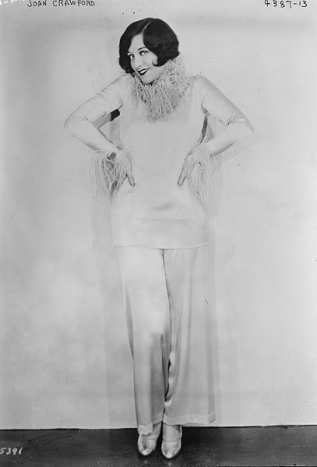


Fashion Designers of the 1920s
Gabrielle Coco Chanel entered the fashion world in the 1920s with her loose shift dresses, blouses, and evening coats in dark and natural shades. Long, belted blouses, and Russian peasant style embroidery simplified the look of women's vesture. In 1926, Coco Chanel claimed to take introduced introduced the Little Black Dress, a manner staple that has endured for 85 years.
- Coco Chanel's jewelry workshop introduced the long chain necklaces and multiple stands of faux pearls associated with the flapper look.
- A new, masculine await offered loose, crewman style trousers for women to habiliment at home and at the embankment. These 'beach pajamas' were an early class of a pants suit.
- Art Deco played a prominent role in the way trends of the 1920s with geometric shapes based on natural lines.
- The discovery of the tomb of Tutankhamen in 1922 set off an instant craze for all things Egyptian. Clothing styles and embellishments reflected designs and patterns of ancient Egypt.
- The designer Jean Patau designed romantic fashions embellished with fine lace, embroidery, and a lavish use of beading. Along with Coco Chanel, Patous' garconne look created a tubular silhouette that de-emphasized the feminine figure by flattening the breasts, narrowing hips, and ignoring the waist.
- In 1922, Jean Patou became the first designer to embroider his initials onto the fabric of his sportswear designs, a concept that is however pop today.
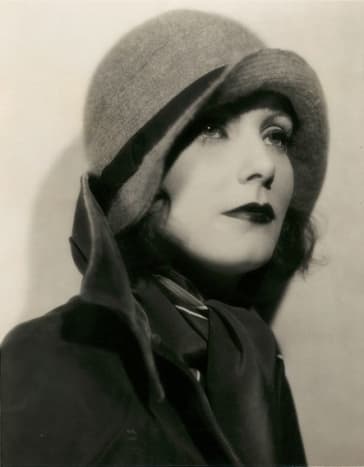


Hair and Hats
Modernistic concepts of hygiene encouraged women toward more frequent hair washing. Emancipation from traditional gender styles encouraged women to cut their long pilus and free them from the complicated hair styles of Edwardian times.
The Bob
The bob appeared in the The states shortly before World War I but actually took hold in the 1920s, infuriating the older generation and igniting controversy about gender and appearance with the new androgynous look.
Women with bobs needed more frequent haircuts. Permanent waves became popular ushering in an explosion of beauty parlors that offered dye jobs and perms, as well as the fashionable new haircut.
Hats and Headbands
Cloche hats were all the rage; narrow, shut fitting, bell shaped hats that frequently featured feathers, bows, chaplet, or artificial flowers.
Flappers held hair out of their eyes while dancing with headbands decorated with embroidery, beads, or a feather. Headbands were frequently worn horizontally across the forehead.
Fabrics
- Natural fabrics like wool, cotton, and linen were yet worn, but technology and mass product offered new, man made fabrics. Rayon, introduced in 1910 equally a faux silk, offered more affordable clothing choices to heart class and lower middle class women.
- Knits became popular for day, sportswear, and evening wear, offering condolement, and stretchability for the increased interest in spots, fitness, and trip the light fantastic.
- Patterns based on the look of Ancient Egypt, and Art Deco gave an exotic, geometric await to clothing styles.
- Fair Isle weave patterns, tweeds, and strips were popular for day wear.
- New technology introduced easier garment closures with zippers and metal snaps.
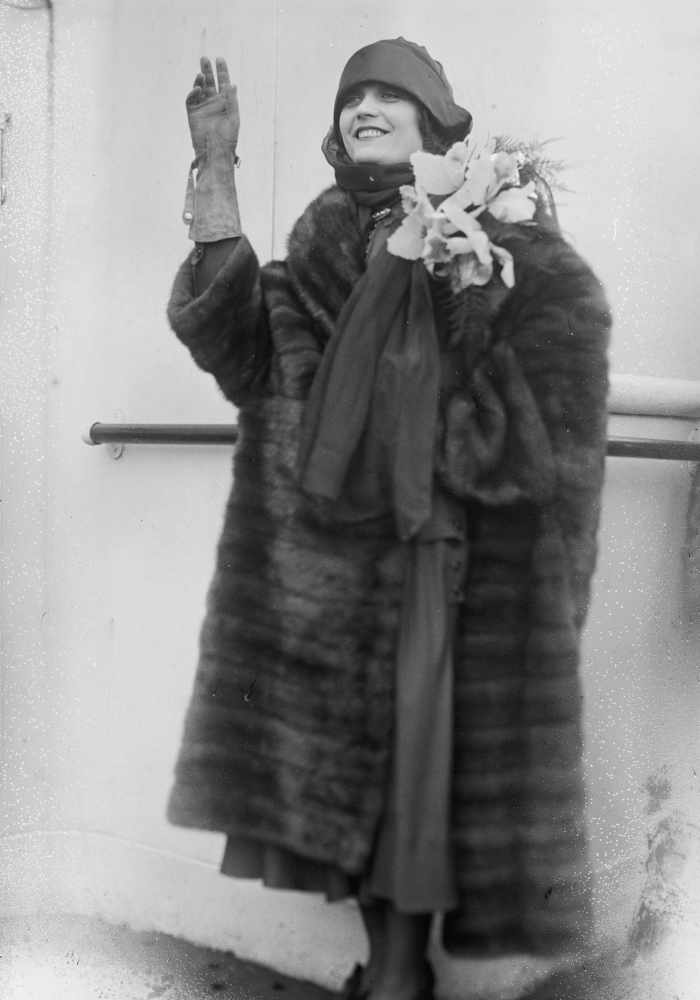
1927 Fur Coat
Uploaded by Kurschner; wikimedia eatables; public Domain
Coats and Shoes
Coats were mostly calf length with the wrapper fashion predominating. The wrap glaze was fastened with a large button or tab and buckle and featured a shawl mode collar ofttimes trimmed in fur. In addition to the familiar furs, coats and collars were sometimes trimmed in monkey fur.
Shoes were generally high heels just over 2 inches. The mass product of shoes in the early part of the 20th century offered the availability of affordable shoes and encouraged young women to by more shoes. Mary Janes and T strap styles with a medium slightly curved high heel were the ascendant shoe of the solar day. Women also wore tied Oxford blazon shoes with a brusk, stack heel for day wear.
Sportswear
As women became more than active, garments evolved to offering comfy motility. Trousers were worn for equestrian sports too as for skiing. Bathing costumes which had been worn for occasional dips adapted for more active engagement in the sea.
Women wore very brusk skirts or bathing dresses that showed more peel than in the past. Some bathing suits omitted the skirts and featured shorts hemmed several inches in a higher place the knee. Stocking began to disappear from the bathing costume merely some women wore the rolled stockings pop at the fourth dimension. Bathing shoes were worn in and out of the h2o.
Bathing beauty contests sprang up in coastal cities where immature women competed for trophies. Competitive swimmers wore simple suits without decorations or skirting.
Bathing Costumes circa 1922
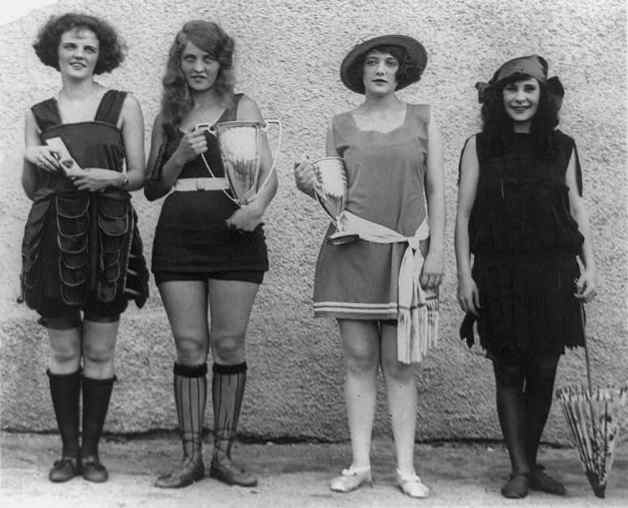
Downloaded past Slowking iv on wikimedia from the National Photo Visitor; PD
1920'southward Girls With Bobs and Radio
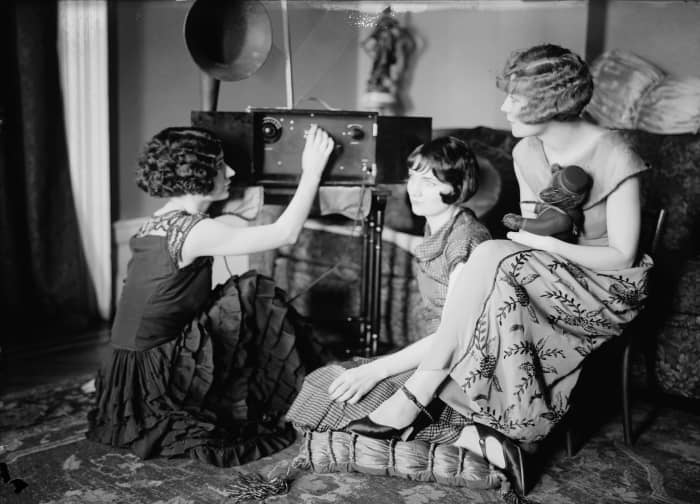
The Brox Sister, Bobbe, Lorraine and Patricia were Broadway and Jazz singers
wikimedia commons; Public Domain
Further Reading
- The Jazz Age - The twenty's - Our American Century; Time Life
- 1920'south America'southward Decades; edited by John F. Wukovits; Greenhaven Press
- American Decades 1920 - 1929; edited by Judith S. Baughman; Manly, Inc.
- Encyclopedia of Vesture and Manner; edited by Valerie Steele; Scribner Library
- Jazz Age Fashion: Dressed to Kill by Virginia and Daisy Bates
- Fashions of a Decade: The 1920s by Jacqueline Herald (curt, a elementary introduction)
- Vintage Fashions for Women 1920s - 1940s by Kristina Harris (for the collector)
Questions & Answers
Question: Have women's fashion styles in the twenties survived or ever been revived?
Respond: The rejection of cumbersome layers and heavy corsets have remained with u.s.. After the 20s, the constrictive styles of hundred of years of discomfort never really returned. Women of the 1920s inverse everything.
The drib waistline was popular over again in the 1960s. Sweater sets popular in and out of manner. Knee length hemlines dropped in the 1930s but rose to the human knee in the 1940s and once again in the 1960s. Long beaded necklaces were popular over again in the 1960s besides. The articulatio genus length pleated skirts of the 1920s have seen various comebacks and never actually went out of style.
Bob hair cuts are popular to this day. Take a look at pictures from the Jazz Age and come across what you think. Take a await at the young lady (in the article here) wearing a striped dress. She would wait in identify today.
Question: How did the fashion of the 1920s capture the spirit of that period of history?
Answer: Women's habiliment styles made a vast alter in the 1920s. Never before had hems been and so high. The rejection of then many layers of vesture, of potent corsets, and complete torso covering shocked the old guard. But the world had likewise changed. Past the 20s, electricity was widely available. Telephones, automobiles, airplanes, moving pictures, radios were commonplace. Gas stoves replaced old wood-burning stoves, and electric refrigerators were on the manner.
Women won the correct to vote in the USA in 1920 empowering a big group of people who previously had no voice. Women had entered the workplace during WWI, giving them a feeling of independence every bit well as some disposable income.
The young women of the 1920s had grown upward during a terrible war, a state of war that was questioned, a huge loss of human life that many suspected was in vein. 1918 ravaged the earth with a flu pandemic that killed at least 50 million people worldwide. Young adults were at the greatest risk of decease.
Information technology was a new world for young women. New freedoms that came after such devastating loss encouraged young women to plough away from the old male-dominated culture, abroad from strict formal attire. The prohibition of alcohol sales in 1920 seemed foolish to many who mistrusted the establishment and flaunted the law.
With this new freedom, after such devastation, what is left but for girls to dance. The new syncopated music would have been difficult to dance to in the old, tight, long dresses. Driving, running to take hold of trams would have been hard in the long narrow skirts of the past. Old costume hampered motion at work and play. Women increasingly took to sports and outdoor activity.
The earth had inverse, and women's way inverse with it.
Question: Did flappers vesture one shoulder dresses for evenings?
Answer: In general, flappers wore dresses to exist comfortable for dancing so a i-shoulder dress would not work very well. If y'all are looking for a dress for a 1920s costume (I am just assuming this) Google paradigm by hunting for accurate pictures of the period. Do not rely on modern approximations or costumes. Once you lot become an idea of the types of dresses the flappers wore for evening wear, you can attempt to observe a mod piece or make on yourself. There are online sites that sell vintage style dresses, some are very beautiful and tin be quite pricey.
© 2011 Dolores Monet
Dolores Monet (author) from East Coast, Usa on July 14, 2020:
Hi Mary - haha, I had a great aunt who had been a bit of a flapper and she, too, still rolled her stockings. I am sorry that the hymeneals dress is ruined but most of the clothing from nearly 100 years agone is gone. I have my female parent's nuptials dress from 1939 and wore it myself when I was married.
mary m on July 13, 2020:
My female parent was married in 1926' She wore a very trendy flapper wedding wearing apparel. sadly the dress went to shreds but i do accept orange blossoms from her veil. My sister had the lace from the tunic which survived nicely removed and had made into a mantilla for her wedding in 1962.My mother rolled her stockings till the day she died. believe me as a teenager i was and then embarassed when she would stop in the middle of the side walk and reroll her stockings.
Dolores Monet (author) from E Coast, United States on Baronial 15, 2014:
Catherine - really! How absurd is that! Your aunts are out in that location for all to see, an iconic glimpse of the by. I love that photograph. Information technology'south my favorite of the lot. Thank yous for sharing the information.
Catherine on Baronial xiii, 2014:
Your image captioned "1920s girls with bobs and radio;" Those are the Brox Sisters (Bobbe, Lorraine, and Patricia.) They were Broadway/Jazz singers in the 1920s. Bobbe was married to Composer Jimmy VanHeusen. They are my nifty-slap-up aunts! :)
Dolores Monet (author) from E Declension, United States on Feb 27, 2013:
amanda - oh me as well. My onetime great aunt was a flapper and my uncle used to tell me how cute she was! Thank you!
The Kemist - thank you. Information technology sure was!
vibesites - thank you! Oh aye, the finding of Rex Tut's tomb was large news and greatly influenced styles of the twenty-four hours. I concur, I call back the xx's and 30's were but fabulous for women's clothing. Many of these styles, y'all could clothing today and fit right in.
vibesites from The states on February 26, 2013:
I enjoyed reading this hub. I wondered why these women and so went Egyptian style, until I read this hub -- and I remember there was also the first "Cleopatra" film back in the 20s. I remember these styles might come back in fashion in mainstream style, or some already have come. The 20s and the 30s are the best eras for women'south way, in my opinion. Voted up, interesting/awesome/beautiful. :)
Dolores Monet (writer) from East Coast, U.s. on March 01, 2012:
drspaniel - at that place's something about women working and short skirts. Mary Quant designed mini skirts to make information technology easier for working girls to run for the bus. Also, with the flappers, the shorter skirts made it easier to trip the light fantastic toe to the new wild music. Cheers for you input!
drspaniel from Somewhere, where the sun shines once a year... on February 28, 2012:
Great videos/photos of an immense change in women's fashion and rights for that affair! Something to note rapidly, is that not all women inverse in the "Jazz age" in fact, most women were stuck in the normal way of life at the time. As for the "flappers", well-nigh of them worked during the solar day equally phone operators and did the worst jobs around.
Pitiful for getting a little carried away at that place, but still this is a really nice Hub, which fully deserves the 100 Hubscore! Congratulations!
Dolores Monet (author) from East Coast, United states of america on August 29, 2011:
susette - Give thanks you lot for commenting and sharing the story about your grandmother. She sounds like i interesting woman. Information technology must have been wonderful to mind to her stories and hear about her life.
Suzette Walker from Taos, NM on August 28, 2011:
Peachy Hub! I love all the photos. My grandmother was a flapper in the l920'south and I have some photos of her that look like yours. She was a hoot! Her town in PA had a Women's Smoking Club which she was invited to join in the 20'southward even though she didn't smoke. The club went into l990's and met once a calendar week to "discuss relevant topics." They were the first in her town to wear women'southward pant suits in the l970'due south. What I loved about my grandmother was that she was always on the cut edge of mode and whatever else was going on at the time. She was a cool grandmother and I miss her very much. She passed abroad in l997, but was still "flapping strong" all the way to the end of her life.
0 Response to "The Jass Age Fashion the Jazz Age Fashion"
Post a Comment